Against your domain names hijacking
As the news have proved it many times, domain names hijackings are more and more frequent and there are many examples (NYTimes.com hijacked towards a page of the SEA – Syrian Electronic Army -, Twitter, BBC, etc.).
Faced with this menace, the Registry lock provides an additional protection to your strategic domain names by preventing any risk of administrative and technical hijacking with a locking and authentication system by the registry.

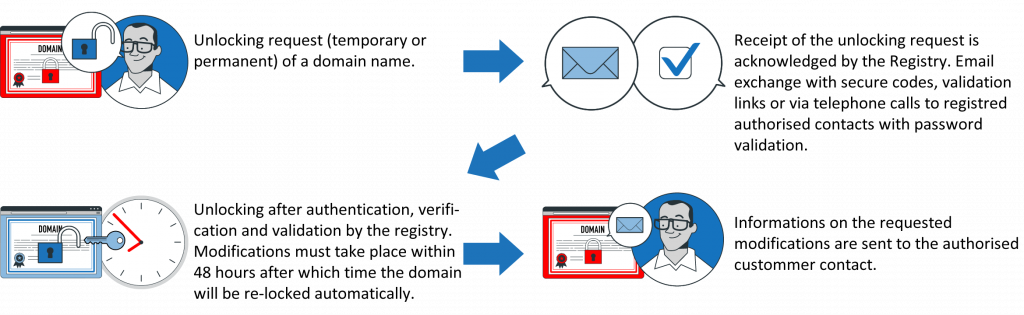
The registry lock allows the domain name owner to indicate to the registry that he wants the lockdown of the domain name’s information. The unlocking is executed after the owner’s authentication, called authenticated contact.
The registry lock blocks a name on different operations like the DNS server modification, the contact modification, the domain transfer and the domain name deletion.
This security mechanism is executed through a highly secured manual process, and provides a protection for all strategic domain names:
The registries that propose this lock and the associated extensions are:
- VERISIGN: .COM / .NET / .TV / .CC / .NAME
- AFNIC: .FR
- EURID: .EU
- ACEI/CIRA: .CA
- TRAFICOM: .FI
- NOMINET: .UK
- DENIC : .DE
- NIC.AT : .AT
- SWITCH: .CH, .LI
This locking service at registry level is recommended for your most strategic domain names. The registry locking service is part of the security recommendations stated by ANSSI (French National Agency of Security of Information) in its guide of the best security practices.
Registrar Lock
All the registries don’t propose the registry lock. Nameshield has also deployed a Registrar lock, in order to address the lack of securing for a strategic domain name which extension might not be covered by a lock at registry level.
On the same Registry lock model, the registration offices can ask to the registry the freeze of a domain name’s data, in order to prevent all operation of fraudulent domain transfer or resulting of a mistake, from a registrar to another, like a transfer of owner.
This mechanism is called Registrar lock and differs from the Registry lock, because the unlocking is managed by the registration office.